Espadrille History: 1322, the YSL Wedge and the Jute Sole
Espadrille history: the shoe that got its name in 1322
An espadrille is a canvas shoe on a rope sole. It comes from Iberia, with the deepest roots in Catalonia, Aragon, the Basque Country. Wikipedia dates its written record in Europe to at least 1322, the year it was first described under its present Catalan name, espardenya. Seven hundred years on, the name hasn't changed.
The grass in the name: esparto and espardenya
Espadrille is a French word, taken via Occitan from the Catalan espardenya. Both it and the Spanish esparteña mean a shoe made from esparto, a tough wiry Mediterranean grass that grows in Spain, Portugal, North Africa and goes into rope and basketry. In Spanish the shoe is an alpargata; in Basque, espartina.
The grass has a longer craft record than the shoe. The Cueva de los Murciélagos near Albuñol in Granada yielded esparto baskets 7,000 years old and esparto sandals from around 5000 BC. A study in Science Advances on September 29, 2023, pushed the most primitive espadrille-like footwear back to 9,500 years ago.
After the Spanish Civil War (1936 to 1939), esparto was declared a "national fibre," complete with a National Esparto Service. Other fibers and plastics later took its markets and the industry declined.
The traditional build: one piece of canvas, seamed to the rope
The classic upper is a single piece of canvas with toe and vamp cut together, sewn to the rope sole along the sides, often with laces at the throat that wrap around the ankle. From at least the 14th century it was the everyday shoe of peasants across the Basque Country, Catalonia, Occitania.
From esparto to jute: the Bangladesh production line
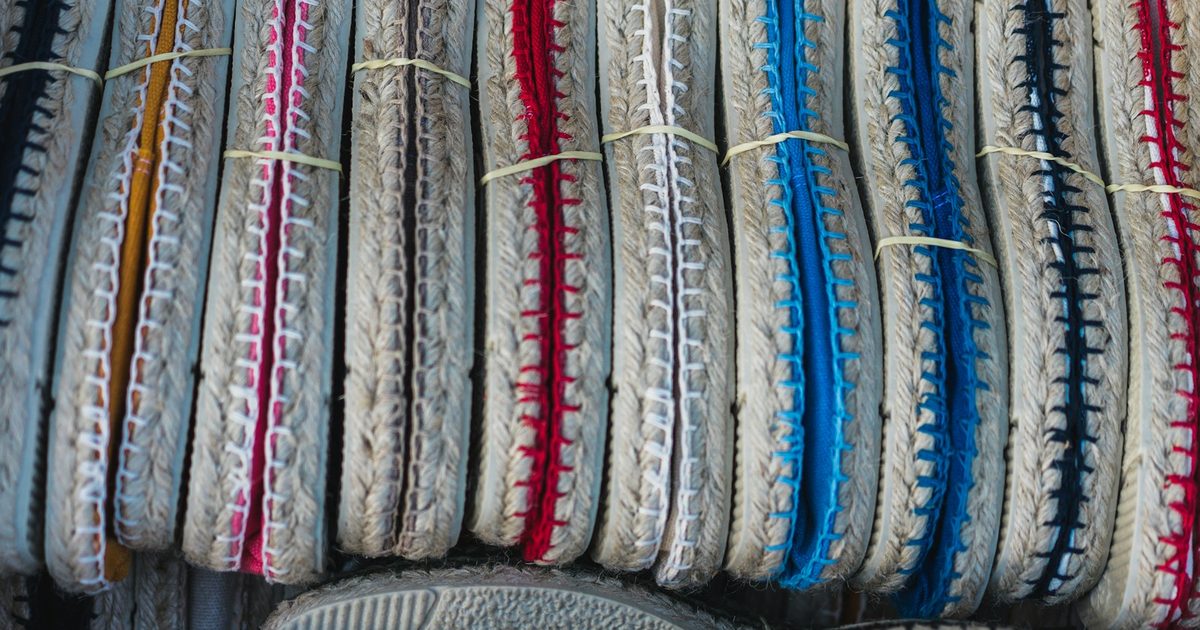
Most espadrille soles are now jute rather than esparto, for reasons of cost and supply. Jute's natural bright white has become a design signature of the modern shoe.
The geography needs care. By FAO figures for 2020, India is the largest jute grower at 1,807,264 tonnes, with Bangladesh second at 804,520; Bangladeshis call it the "golden fiber." Wikipedia's espadrille entry says Bangladesh produces high-quality jute and has become a center for premium jute soles and finished espadrilles, with some makers in Spain, in France and in Italy importing soles from there to finish at home.
The process, as Wikipedia describes it: jute twine is machine-braided; the braid is coiled by hand into a sole shape and hydraulically pressed with heat; it's stitched vertically with espadrille needles; the underside is vulcanized. For a wedge, a wooden or EVA heel is glued on and wrapped in more braid. The upper goes on last.
Lauren Bacall in 1948, the YSL wedge in 1970
Espadrilles caught on in the United States in the 1940s. In Key Largo (1948), Lauren Bacall's character wears a pair laced at the ankle. Wikipedia's list of 20th-century figures who popularised the shoe runs from Picasso and Salvador Dalí to John F. Kennedy and Yves Saint Laurent.
The wedge dates to 1970. Saint Laurent had spent months looking for someone to make him a wedge espadrille. At a Paris trade fair he met the Spanish maker Castañer, who worked out how to build it. The shoe was an instant hit and is still in production.
The 1980s revival in America came through Miami Vice, on the feet of Don Johnson's Sonny Crockett. By 2013 a pair in a New York luxury shoe store could cost close to $500.
What to wear it with
Wedges go with wide-leg and linen trousers, canvas against linen. Flats are the easy answer for a summer dress. Judge a pair by the sole: the density of the jute braid and the finish of the vulcanized edge tell you most of what you need about the make.
For the fabric it usually sits under, see linen explained. For what the Resort 2027 collections shown in summer 2026 are wearing, see also Resort 2027 trends.
"A peasant shoe waited 648 years for its wedge. Some designs don't need rushing." — Guushu Design Team