Linen Explained: 30,000-Year Fibers and a 5,000-Year Dress
Linen explained: why it feels cold, why it creases, and who grows it
Linen is cloth woven from the bast fibers in the stem of the flax plant. It feels cold to the touch for the same reason metal does: high thermal conductivity pulls heat off the skin fast. What follows is the physics, the history and the fieldwork, drawn from the Wikipedia entries on linen, on flax and on the Tarkhan dress, plus two Vogue pieces.
Cool, strong, creased: the physics of linen
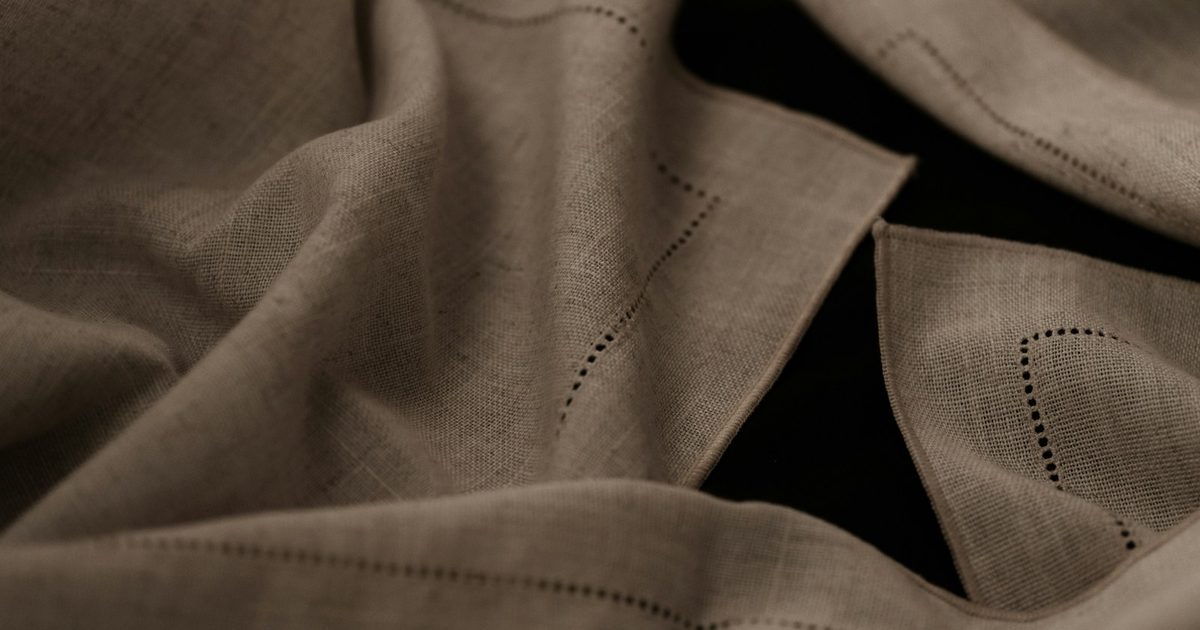
Flax fibers run 25 to 150 mm long, far longer than cotton's, and the finished cloth can be up to three times as strong. Wet, it gains about 20% more tensile strength. It absorbs moisture and dries faster than cotton, which is the whole case for wearing it in heat.
The crease is the flip side. Flax has poor elasticity, so linen creases as soon as you sit. Wikipedia adds a warning worth keeping: fold it sharply in the same place over and over and the threads will break. It doesn't pill or shed lint, softens with every wash, and irons most easily while still damp.
The flaw people used to mind was the slub, a short thick stretch in the yarn. Slubs once marked low-grade linen. Many current linens sell them as texture.
Dyed fibers from 30,000 years ago, a dress from 3482 BC
The oldest trace is in Dzudzuana Cave in Georgia: wild flax fibers that had been spun and dyed, more than 30,000 years old. The study appeared in Science on September 11, 2009, under the title "30,000-Year-Old Wild Flax Fibers."
Egyptians wore white linen by day and were wrapped in it after death. Plutarch wrote that the priests of Isis wore it for purity. The oldest surviving woven garment, the Tarkhan dress, is linen. Flinders Petrie dug it out of the Tarkhan cemetery south of Cairo in 1913, after which it sat in a University College London storeroom for 65 years.
In 1977, conservators from the V&A recognized it while sorting a pile of "funerary rags." Radiocarbon dating in 1978 put it at about 2362 BC; a 2015 Oxford test moved it back to between 3482 and 3102 BC. The weave counts 22 to 23 warps and 13 to 14 wefts per centimeter.
Retting, scutching, heckling: why linen costs more than cotton
For long fibers, flax is pulled up whole or cut right at the root. After the seeds come off, three steps follow. Retting lets bacteria dissolve the pectin that glues the fibers together; dew retting in the field takes a month or more and gives the best fiber. Scutching, done from August to December, crushes the woody stalk between two metal rollers. Heckling combs out the short fibers and keeps the long soft ones.
Wikipedia's verdict is "laborious to manufacture," made in relatively small quantities and priced accordingly. The plant itself needs about 100 days from sowing to harvest.
Who grows it and who weaves it: France's 75%
FAO figures for 2022 put world output of raw or retted flax at 875,995 tonnes. France grew 652,680 of them, 75% of the total, with Normandy alone close to a third of the world's crop. Belgium came second at 77,910 tonnes.
Woven cloth is a different map. In 2018 UN trade data, China was the top exporter of woven linen fabric at $732.3 million, followed by Italy at $173.0 million, Belgium at $68.9 million and the UK at $51.7 million.
The end use shifted too. In the 1970s about 5% of linen went into fashion fabric. By the 1990s the share was about 70%.
On the runway and the rail, 2025 to 2026
On June 29, 2025, Simon Porte Jacquemus showed Spring 2026 at the Orangerie of Versailles. Vogue Runway's Sarah Mower reported that he called the collection "humble," meaning cotton and linen and the world of embroidered tablecloths, aprons, headscarves, in honor of his farming family.
On June 1, 2026, Vogue's Kristina Rutkowski, rounding up linen trousers, noted two shapes on the rise for summer 2026: fisherman pants and, once again, capris.
For summer's other handmade fabric, see crochet and slow fashion. For the shoe that goes with all this linen, see also the espadrille's history.
"The Tarkhan dress lay unrecognised among rags for 65 years. That is one way to prove a fabric lasts." — Guushu Design Team