Pleats Explained: Knife, Box, Accordion and Fortuny
Pleats explained: four ways to fold cloth, and one gown nobody can copy
A pleat is cloth folded back on itself and held. The earliest surviving examples are linen shirts pleated with the plissé technique, found in 10th-century Viking graves at Birka in Sweden. A thousand years on, the folds sort into a few families, each solving a different problem.
Knife pleats: the 3:1 ratio
Knife pleats all turn the same way. The traditional ratio is 3:1, three inches of fabric for one inch of finished pleat. School skirts and most "pleated skirts" are knife pleats.
Box pleats: two knife pleats back to back
A box pleat is two knife pleats facing away from each other, also at 3:1. It springs out from the waist and adds volume. Stacked into a double box pleat the ratio rises to 5:1.
Accordion pleats: closed at rest, open in motion
Accordion pleats are knife pleats packed tight into a zigzag. They stay shut when you stand still and fan open near the hem when you move, which is why dance dresses use them.
Cartridge pleats: a lot of cloth into a small waistband
Cartridge pleats gather a large amount of fabric into a narrow waistband or armhole without thickening the seam. They were everywhere in 15th- and 16th-century dress and came back in the 1840s to hold up bell-shaped skirts.
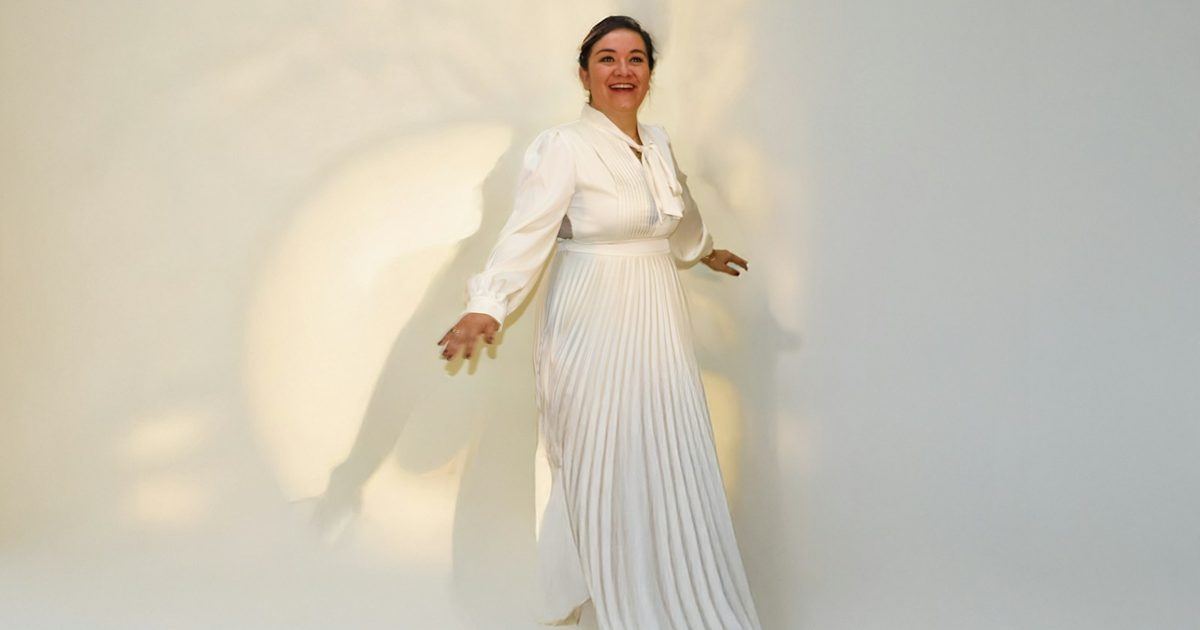
Fortuny pleats: the Delphos gown, about 1907
The Delphos gown was created around 1907 by the French designer Henriette Negrin and her husband Mariano Fortuny. Negrin designed it; Fortuny filed the patent and credited her. Its silk carries fine, crisp pleats set by a process that was kept secret and is still not understood.
The name comes from the Charioteer of Delphi. Murano glass beads run along each side seam, strung on silk cord, and they're there to weight the fabric so the pleats hang straight. Proust called it "faithfully antique but markedly original." Lauren Bacall wore a red one to the 1978 Oscars.
Pressed or unpressed
Every pleat ends up one of two ways. Pressed pleats are ironed or heat-set into a sharp crease. Unpressed pleats fall in soft rounded folds. Pleats sewn down are called tucks. The same fold reads completely differently under the two treatments.
How to choose
- For crisp lines, pressed pleats in synthetic fibre. For soft drape, unpressed folds in natural fibre.
- Fine dense pleats read light. Wide box pleats have presence.
- Don't store sharply pressed pieces folded flat for months.
For how these folds showed up in spring 2025, see pleats for spring 2025. For wearing them day to day, see how to style a pleated skirt.
"The beads on a Delphos gown are ballast. Looking good is a side effect. Good design is often like that." — Guushu Design Team